Friday, March 1, 2013


Last week Rabbi Sollish came to our class to show the children how the Sofer (scribe) writes the Torah, here is some of what transpired:


Rabbi: What do you write with?
Jonah: Pencil
Felix: Marker
Sholom: Crayons

Rabbi: What's behind my back?
Jonah: A feather
R: Right and what type of bird does it come from (it was a white feather)?
Yael: A white bird
Felix: A seagull
Eden: A snow owl
R: It's from a turkey
Talia: My sister saw a turkey

R: What do you need to write?
Jonah: Ink, my sister has ink.
R: It has to be from a kosher animal
Vivian: It can be from an animal that's food

R: Whats in this bag? (showing a bag for everyone to see with rolled parchments)
Asher: Nails
Dovy: Paper
Luba: A Torah

R: What do you make paper out of?
Vivian: Tree
Yael: Wow!

Rabbi wrote his name using all of the above and showed it for the class to see.
Motty showed an interest in seeing something written in Hebrew letters.

Rabbi showed his name in Hebrew letters.
The first letter was an aleph
R: Who's name starts with an aleph?
A few yeladim: Iyar!

Estelle hugged Nina saying, "we are friends, lets listen together"

Dov said "thank you" for  coming!
Morah, Estee

One Hundredth Day of School

KDH has been counting, quite literally for 100 days, since the first day of school in August. All week long we spent time counting as the excitement mounted. Today we celebrated!
At circle time we estimated how many clementines came in the bag. One day we put manipulatives in piles of five. How many piles did we need to reach 100? We love to count by 10’s to 100. The teen numbers are a bit tricky but we are mastering them using our Montessori math set.
Everyone came in today with their Show and Tell of 100. We had 100 stickers, pieces of lego, pompoms, pennies, pictures of cars, cheerios, and magnets.  The question on our morning board was, “How many days have you come to school?”
Center time: Menny and Mendel made ten piles of ten pieces of Lego to reach 100. Then, they built a structure out them!


Art: Each child chose from foam flowers, sticky note flowers, colored squares, sequins, toothpicks and more to place ten of each on circles that were marked 10, 20, 30…to 100. After the counting came the art. Each child made a 100 day collage with their collection.  100 day glasses was another fun art activity.


Music with Morah Adina: Songs about numbers, using a rain stick that definitely had more 100 pieces inside to make noise.
Snack:  Trail mix the children made with ten pieces of ten foods. Yum! Great party.


Science: We took out various sized jars, water and a dropper. “What size jar to you think we need for 100 drops?” was the question posed. We were all surprised that the smallest baby food jar was even too big. The drops all fit on one plastic teaspoon.

Movement: Can you jump 100 times? How far can you go with 100 steps?
Literacy: The 100th Day of School and this poem by Meish Goldish.

100 dogs, 100 cats,
100 heads for 100 hats.
100 women, 100 men,
100's more than 5 or 10.
100 buttons, 100 coats,
100 sails for 100 boats.
100 cookies, 100 cakes
100 kids with bellyaches!
100 shoes, 100 socks,
100 keys for 100 locks.
100 puddles mighty dirty,
100's even more than 30.
100 daughters, 100 sons,
100 franks on 100 buns.
100 trees, 100 plants,
100 picnics, 100 ants!
100 is a lot to count,
100 is a LARGE AMOUNT!
100 kisses, 100 hugs,
100 bats, 100 bugs.
100 bees, 100 birds,
This poem has 100 words!
Even Tefilla was part of the 100th day activities. We took 100 pennies, divided them among the class and gave them for tzedakah. We want to think of others while we are having fun.
We ended our day putting our hands into a circle of 100 fingers.

This was so fantastic, we really should have celebrated for 100 hours!

Morah Ruth

Thursday, February 28, 2013

Making Impressions

 
In my training as an art educator, a materials-based approach was stressed. This is the notion that different materials provide different experiences and accomplish different learning objectives. The one objective that is constant in all art experiences is problem solving. At some point, the child looks at what the teacher has placed in front of him or her and asks themselves, "How do I use these?" The next question is, "How do I use these...to make what I want?" This is why exploration is so important- allowing children to handle materials, get frustrated, try again, and experience true success.

And as the teacher, watching closely and knowing when to interject with some helpful words, and when to hold back. This is why teaching is an art. It's knowing when, how, and what to say. It takes lots of practice, you can do it your whole life and still not perfect it, it's impossible to get it right every time, but that's what keeps it interesting.

How does this relate to today? On Tuesdays and Thursdays, I spend the day with Kitah Gimmel. This morning at the art center, the table was set with a bowl of chunky crayons with the paper peeled off, texture rubbing plates (like this), and white paper.

Iyar sat down, placed a paper on top of the plate, and moved her crayon across the paper. She happily made spiraling lines on the paper, holding the crayon in the traditional vertical grip. She paused for a moment and seemed to be thinking of what to do next.

Seeing a good moment to join the process, I pointed out that these crayons have the paper peeled off, and I wonder what would happen if you held them sideways, with your thumb on the bottom, pointer and middle finger on the top, and moved them over the paper this way?


Iyar tried it and was delighted with the results. She started out holding the paper still with her left "helper hand," and then began turning it around and around as she colored. "I'm making a rainbow!" she said. 


I watched her make a few more rubbings, trying different colors and different techniques before moving on to the next station. 

What do we learn from this seemingly small encounter? That school is one big conversation between the teacher and student; The teacher can "teach"- show or tell how to do something- but it only becomes meaningful through the child's interpretation.

Tuesday, February 26, 2013

Face Painthing

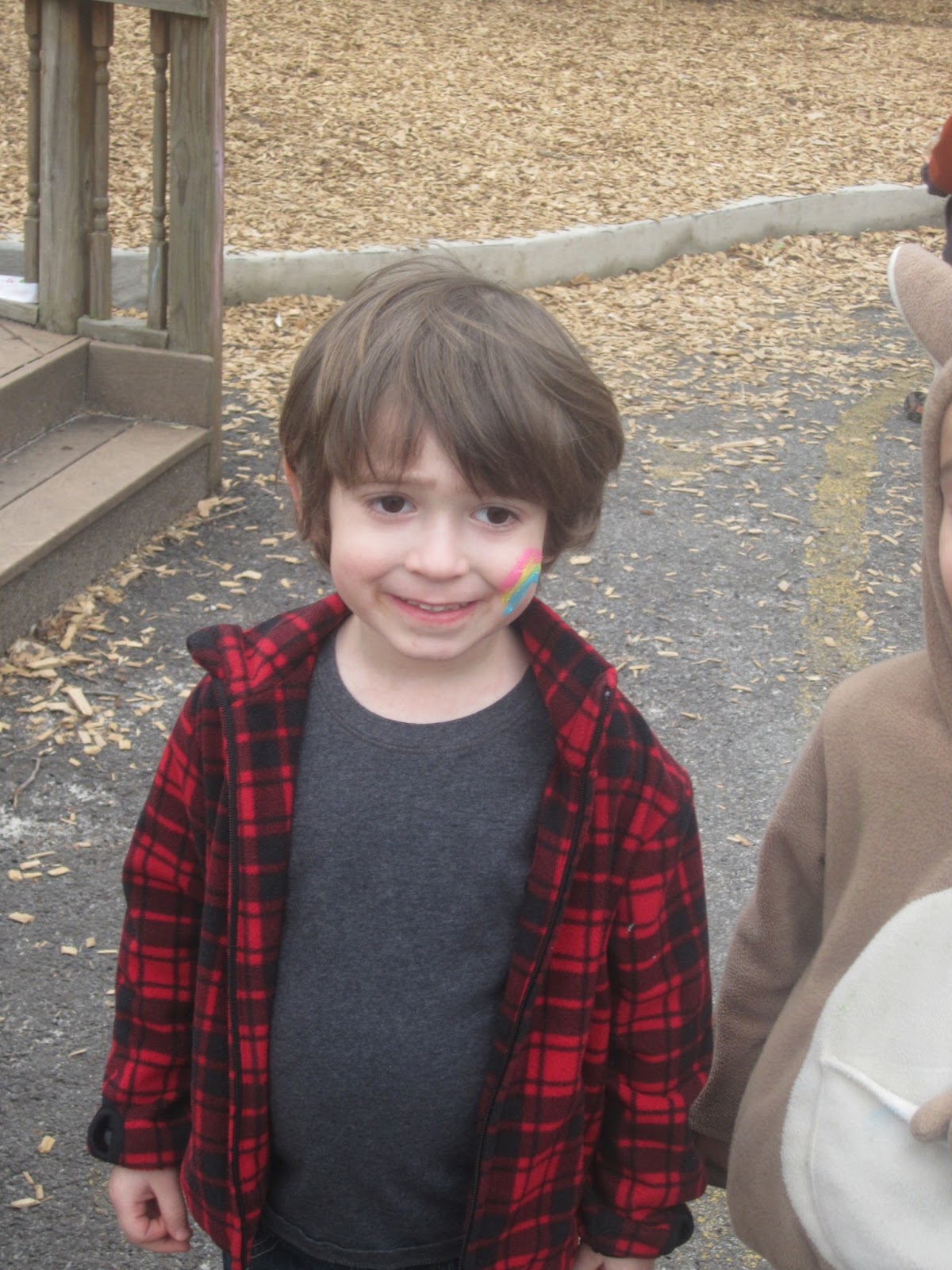
What would  masquerade day be without face painting??! To add a new twist to this Shushan Purim activity, KDH children made their own face paint from scratch. The recipe is:

¾ teaspoon of cornstarch
½ teaspoon thick/heavy facial lotion
¼ teaspoon of water
1-2 drops of food coloring

What do you think is most frequently requested to be painted on a cheek? Rainbows! 

Theo and Enaiv help make the face paint


Morah Ruth

Friday, February 22, 2013

Purim Self Portraits

The children used water soluble pastels to draw their pictures. These pastels are fun to draw with. The children dip the pastels into water before drawing and then they glide on and look like paint. The other method used is to draw with dry pastels, then take a paint brush dipped into water and soften and blend the colors.Purim self portraits just added to our Purim fun!